Authors:

Jiricepelka.scrt

Reserve currency for Cosmos
What should become reserve currency of Cosmos ecosytem?
23.6.2023
-Jiricepelka.𝕊crt/a³
Cosmos path
Cosmos is still a fairly disparate ecosystem, but it will be forced to take one of the paths of what will be its main financial asset that will serve as a center of both value and liquidity.
The goal of research is to find the best one.In practice, we know of several types of financial assets that can serve as network value:
Backed by real yield
These assets are supported by generating their own revenue, this motivating people to hold them, one of these assets can be for example Ethereum ( and its liquid staking derivatives ), or from Cosmos INJ and KUJI ( in the future maybe also SHD )
Synthetic and indexs
In this case, these are special and non-traditional assets, which can be both synthetic (such as SILK, or derivatives of shares from the already dead Mirror Protocol), and can also be idexes such as IBCX, which brings together the best Cosmos projects and forms one index from them, so an individual, company or DAO does not have to worry about what they buy with IBCX, they automatically get exposure to the most interesting assets on Cosmos
Based on trust ( speculative )
This type includes funds that use trust as the main motivation (i.e. they do not generate any significant income for their holders that is not associated with a net increase in price), among them we include BTC and partially ATOM
These are assets with a lot of trust from the community, who often hold them only because others hold themThe motivation to hold can be compared to the motivation to hold NFTs, people just want to be a member of a community, or they want to make money from it
Real yield:
ETH, the ultra-sound power
Probably everyone here knows Ethereum, it's the first high quality, Turing-complete network with propgrammable applications that completely switched to the Proof of Stake consensus 9 months ago.
What fewer people know is that Ethereum is the most mature prot
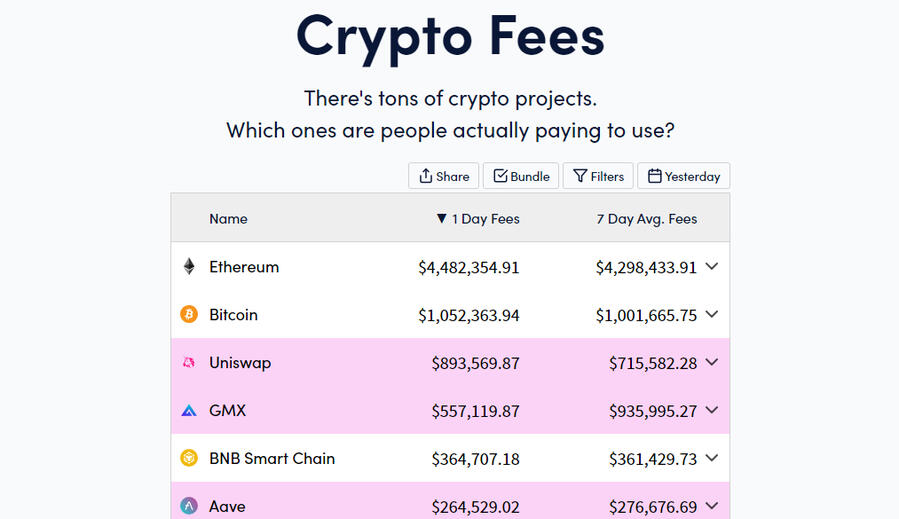
cryptocurrency ( at least in terms of fees, i.e. protocol revenue )The economic structure of ETH is as follows:
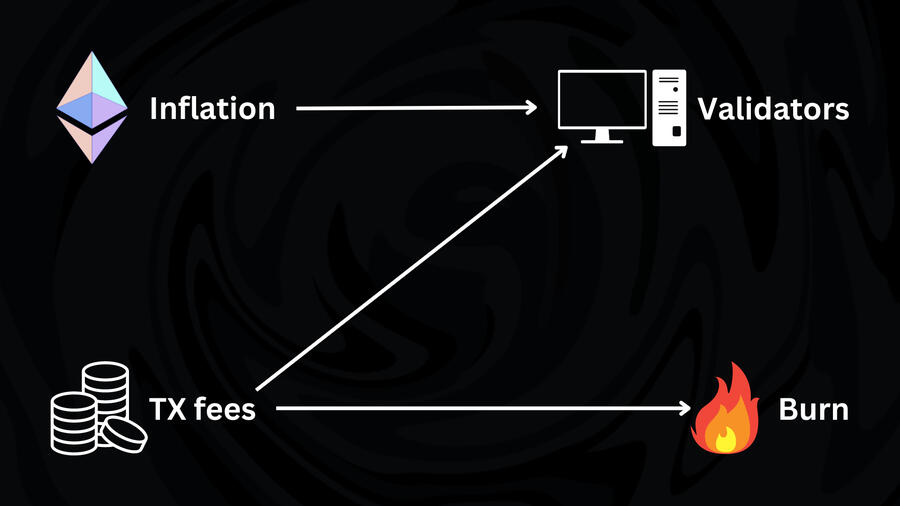
The transaction fee is divided into a validator tip and EIP-1559, the validator tip is the fee that the validator ( ETH holder ) receives and EIP-1559 is the fee that is irretrievably burned thus creating deflation
Besides, Ethereum also has inflation which goes to the validators ( if the fees are above about 19 gwei so Ethereum remains deflationary despite inflation )
INJ, KUJI and SHD
Given the size of these protocols, we will summarise them in one sectionINJ is the first layer, whose flagship is the decentralized perpetual exchange, from here also pline most of the fees profits.
Fees are paid in USDT, which is then offered in exchange for INJ at auction ( practically a buyback ), the redemption of INJ is burnedKujira is a decentralized first layer with a non-inflationary token ( KUJI ) and also a rich DeFi ecosystem, from orderbook you can find here loans, decentralized stablecoin USK and also onchain DCA
Fees goes to the validators/delegatorsSHD is token of Shade protocol, It has a wide range of products, from stkd-SCRT ( Secret Network LSD ), to loans, an DEX and its own decentralized index overcollateralized stablecoin called SILK
Fees from those products will be paid to SHD stakers